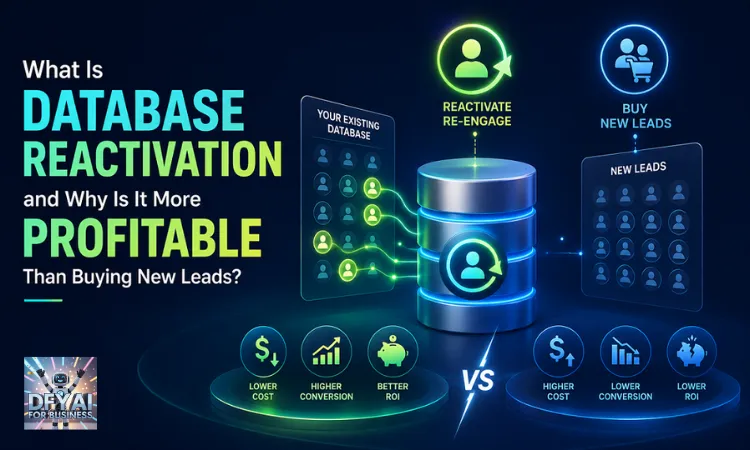
What Is Database Reactivation and Why Is It More Profitable Than Buying New Leads?
Here's a question worth sitting with: if your business spent money generating leads over the past two years, where are those leads now?
Some converted. Some didn't. And the ones that didn't? They're probably still in a spreadsheet or CRM somewhere, labelled "cold" or "not interested" and quietly forgotten. Meanwhile, the marketing budget is going towards generating brand new leads from scratch.
That's not necessarily wrong. New leads are always useful. But treating your existing database like a write-off while spending to replace it is one of the most common and quietly expensive mistakes in local business marketing.
Database reactivation Services is the process of going back to that existing list and systematically identifying who is now ready to buy. It sounds straight forward, and in principle it is. The reason most businesses don't do it isn't because they've decided it doesn't work - it's because doing it manually is tedious, inconsistent, and easy to deprioritise.
That's changed with AI.
What Database Reactivation Actually Involves
The starting point is your existing contact list. This might include:
Leads who enquired but never booked
Past customers who haven't returned in six months or more
People who requested a quote but chose someone else
Subscribers who opened your emails once and then went quiet
Anyone who contacted the business and didn't convert at the time
The goal is to re-open a conversation with these people in a way that's relevant and timely - not a generic mass email, but outreach that acknowledges their history with the business and gives them a reason to re-engage.
Done well, database reactivation consistently outperforms lead generation campaigns on cost per acquisition. The maths are straightforward: you're not paying to reach strangers. You're reaching people who already know your business exists, already showed enough interest to make contact once, and may simply have been waiting for the right moment.
Why It's More Profitable Than Buying New Leads
New lead generation has a cost structure that most business owners accept without questioning it much.
Pay per click. Pay per lead. Agency retainers. Platform commissions. The costs vary, but the principle is the same: you're paying for access to people who've never heard of you, with no guarantee any of them will buy.
Database reactivation works on a fundamentally different cost structure. The contacts already exist. You don't pay to acquire them again. The only cost is the outreach - which, with AI, is significantly cheaper than a sales team running manual calls - and the time it takes to set up the campaign.
The conversion rate on reactivated leads tends to be higher too. Someone who enquired about your service once, got distracted, and is now being reached at the right moment is in a different position to a cold prospect seeing your ad for the first time. They know the business name. They've already mentally categorised you as an option. The barrier to re-engagement is lower.
In terms of return on investment, reactivation campaigns at DFY regularly produce results that are difficult to match through new lead generation: revenue recovered from lists that were effectively dormant, at a fraction of the acquisition cost.
The Common Objection: "Those Leads Already Said No"
This comes up a lot. If they didn't convert the first time, why would they now?
A few reasons.
Timing: A lot of leads don't convert because the timing was wrong, not because the answer was no. Someone enquiring about a loft conversion in January might genuinely not be ready to proceed until April. Someone who requested a restaurant loyalty offer might have moved away and recently come back.
Circumstances change: The customer who got three quotes and chose the cheapest option may have had a poor experience and is now open to trying someone new. The homeowner who said "not right now" twelve months ago may have had exactly the right amount of time to reconsider.
Follow-up gaps: A significant proportion of leads don't convert on the first contact. They need two, three, sometimes five touchpoints before they're ready to move. Most businesses stop following up after one or two attempts. Reactivation picks up that thread.
What the AI Does That Humans Can't Consistently Do
Manually working through a database of hundreds of contacts is unrealistic for most small businesses. It takes time people don't have, and the quality drops fast once the work gets tedious.
AI outreach - whether through automated SMS sequences, personalised email campaigns, or AI voice calling - runs systematically through the entire list without dropping quality. Every contact gets a timely, relevant message. Responses are tracked. Positive replies are flagged and followed up. Bookings land in the calendar.
The business doesn't have to manage the process day to day. The system runs, the results come in, and the team handles the re-engaged customers.
Is Your Database Worth More Than You Think?
Most business owners who run a reactivation campaign are surprised by the results, not because the concept is new, but because they'd underestimated how much untapped value was sitting in a list they'd stopped thinking about.
DFY Marketing Services audit, segment, and run the full AI reactivation process for our clients.
