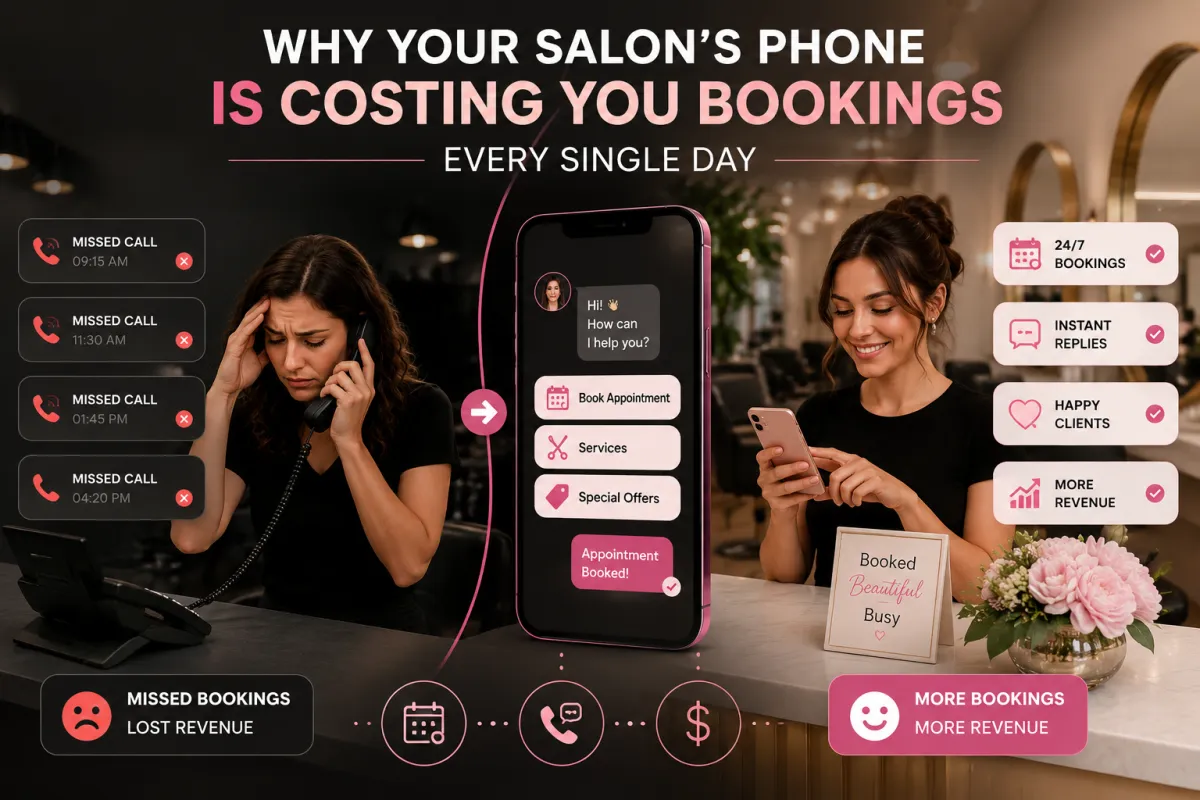
Why Your Salon's Phone Is Costing You Bookings Every Single Day
Here's a scenario that plays out in salons across the UK dozens of times a day.
You're in the middle of a highlights appointment. Both hands occupied, a client in your chair, forty minutes of foils ahead of you. Your phone rings. You glance at it - unknown number - and let it go to voicemail.
The caller doesn't leave a message. They never do. They open Google, find the next salon in the results, call that one, and book in.
You never knew the call came in. You never had a chance to respond. From your perspective, nothing happened. From the client's perspective, they tried your salon and couldn't get through, so they went elsewhere.
That's not a one-off. For salons that are busy - especially solo operators who are with clients for most of the day - this is happening multiple times every working day. And because there's no record of the missed connection, it never shows up in the numbers. The business just quietly grows a little more slowly than it could.
Why This Problem Is Worse for Solo Beauty Professionals
For a salon with a receptionist or a front-of-house team member, missed calls are a manageable problem. Someone picks up the phone while the stylist or tech is with a client. The booking gets made.
For solo nail techs, lash artists, brow specialists, and self-employed stylists working independently, there is no one else to answer. The options are: stop mid-appointment to take the call, let it ring out, or turn the phone off entirely.
None of these are good. Taking calls mid-appointment is unprofessional and disrupts the client experience. Letting calls ring out loses the booking. Turning the phone off entirely means clients can't reach you at all.
The result is a ceiling on growth that most solo beauty professionals hit and don't fully understand. The appointment they're in prevents them from booking the next one. The busier they get, the more enquiries they miss. It's a paradox that's extremely common and rarely talked about directly.
The Numbers Behind the Missed Call Problem
There's no universally published figure for how many salon bookings are lost to missed calls - the nature of a missed call means it's difficult to track. But some reasonable estimates help frame the scale.
If a busy salon or solo operator misses an average of three booking enquiries per day - a conservative figure for anyone working back-to-back appointments - and converts those at the average appointment value of £70, that's £210 per day in potential revenue that never materialises.
Over a five-day week: £1,050. Over a month: £4,200. Over a year: more than £50,000 in enquiries that never became bookings.
Even if the actual conversion rate on those enquiries is 50% - accounting for people who were just browsing, or who would have called three other salons regardless - you're still looking at £25,000 a year in revenue that walked away because no one picked up.
The Outdated Advice That Doesn't Work Anymore
The traditional response to the missed call problem is "set up voicemail and call people back."
This made sense when people left voicemails. Almost nobody does anymore. Research on consumer communication behaviour consistently shows that the majority of callers, particularly for service bookings, will not leave a voicemail if a call goes unanswered. They move on immediately.
The second piece of advice is "add an online booking system so people don't need to call." That helps - and online booking is a genuinely useful tool - but it doesn't capture everyone. A significant portion of clients, particularly older ones or those with specific questions about services, prices, or availability, still want to speak to someone or at least get an immediate response before committing to a booking.
An online form that says "we'll get back to you" doesn't satisfy that. It creates another gap where enquiries can cool off before anyone responds.
What Actually Solves This
The most effective answer to the missed call problem isn't a new phone system or a better voicemail message. It's a combination of two things working together: an AI call handler and a social chatbot.
The AI call handler picks up every call your salon can't take - whether you're with a client, on a break, or closed for the evening. It greets the caller, answers common questions about your services, prices, and availability, and either books them in directly or captures their name and number for an immediate follow-up message. The caller gets a response. The booking opportunity doesn't disappear.
The social chatbot covers the same gap across Instagram DMs, WhatsApp, Facebook Messenger, and your website. When a client messages at 10pm asking whether you have anything available on Saturday, they get an immediate reply - not a "we'll get back to you" holding message, but an actual, useful, on-brand response that either books them in or keeps the conversation moving.
Together, these two systems close the window where most enquiries are currently being lost. Every incoming contact gets a response. Every booking opportunity gets a proper chance to convert.
What This Means for Salon Growth
The ceiling that missed calls create - where getting busier makes it harder to take new bookings - disappears when the response function is automated.
You can be fully booked with clients all day and still be taking enquiries, handling questions, and securing bookings for next week. The two things run in parallel rather than competing for your attention.
For solo beauty professionals especially, this changes the practical upper limit on what the business can do. The appointments you're already in stop being a barrier to the ones you haven't booked yet.
DFY Marketing Services builds and manages AI call handling and social chatbot systems for beauty businesses across the UK. No missed calls. No missed bookings.
